The AI Tutor will answer grounded in this lesson's cited source (portal_guide: PRD-109) and key concepts — authority Informational. Not yet enabled.
AI Agent Control Tower
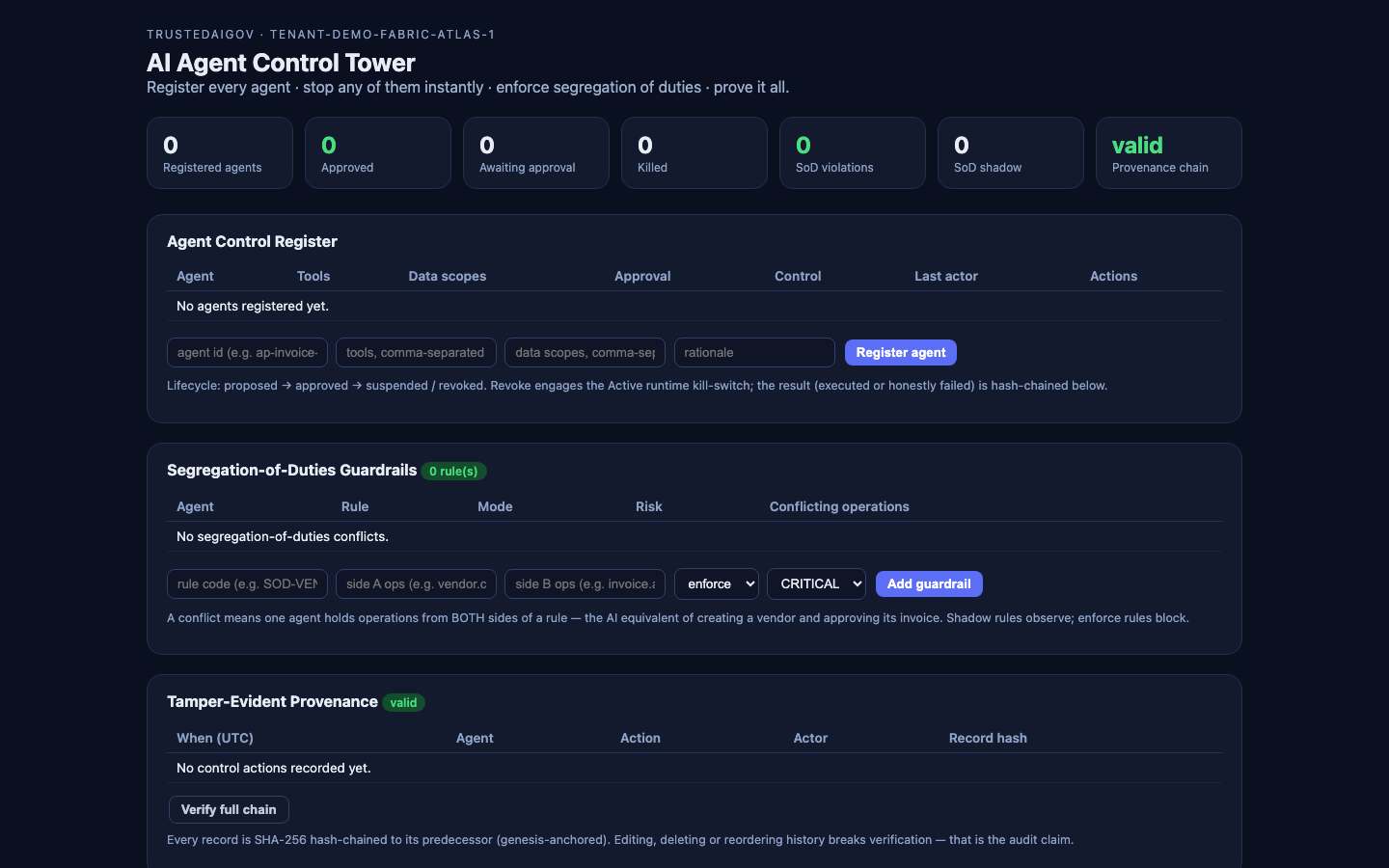
What it is. Runtime control over your AI agents: register every agent, gate it through approval, bind segregation-of-duties rules between agents, stop any of them, and prove the entire control history with a hash-chained record.
Who it's for. Risk and security owners scaling agentic AI who must answer: "which agents run, who approved them, and can you stop one — provably?"
Features and what they mean
| Feature | What it means |
|---|---|
| Agent Control Register | Every agent registered with its tools, data scopes and rationale; lifecycle proposed → approved → suspended/revoked. |
| Kill switch | Revoking an agent engages the runtime kill-switch — live in production, isolating the mapped runtime system; the result — executed or honestly failed — is recorded either way. See the dedicated Kill Switch lesson. |
| SoD guardrails | Rules with two operation sides (e.g. create vendor vs approve invoice): an agent holding both sides is a conflict. Shadow mode observes and logs "would have blocked"; enforce mode blocks. |
| Tamper-evident provenance | Every control action is SHA-256 hash-chained to its predecessor; a verify action checks the full chain. |
What you put in, what you get out
| You put in | You get out |
|---|---|
| Agent registrations (id, tools, data scopes, rationale) | A live control register with approval state |
| SoD rules (rule code, side-A ops, side-B ops, mode, risk) | Conflict detection — logged in shadow, blocked in enforce |
| Control actions (approve, suspend, revoke) | Execution results plus a verifiable provenance chain |
Your first session
- Open AI Agent Control Tower from your workspace.
- Register one real agent honestly — tools and data scopes included.
- Add one SoD rule in shadow mode and let it observe before you ever enforce.
- Run Verify full chain — then try to imagine editing history without breaking it. That is the audit claim.
Honest limits
Physical enforcement lands on agents that are mapped to a system registered in the Active runtime — an unmapped agent still gets a fully recorded, hash-chained revocation, but the kill has nothing to land on and the result says so honestly. Enforcement is all-or-nothing per system (isolation, not throttling).
Access: AGENT_CONTROL_TOWER entitlement (14-day trial SKU) plus its feature flag; surface at /agent-control-tower.